

Guitars are notoriously delicate and fragile musical instruments that have not been designed to be tossed around inside a moving vehicle. For a valuable instrument, consider whether to pay for packing help and confirm that the provider has suitable instrument-handling experience. In fact, guitars don’t enjoy being moved too much – they like it when they are sleeping motionless in their hard or soft cases and when they are kept stationary on their guitar stands. The only gentle movement they are known to appreciate is when somebody is bringing beautiful notes out of them, either strapped to that person’s shoulders or cuddled on their laps.
If you own a guitar and you’re moving house soon, then you’ve got yourself a minor issue to deal with – how to pack your guitar for moving. And even though packing a guitar for shipment will not be the most challenging task you’ll face when moving from one home to another, you should still do it right to avoid any type of untimely damage to your prized possession.
How to pack a guitar for moving? Pay attention to the preparation and packing steps below that outline the best way to pack a guitar for a move, for one careless or uncalculated movement may ruin your expensive stringed instrument for good.
What to know before packing a guitar for moving
Sure, you can’t possibly compare the difficulty levels of moving a piano to a new home on one hand, and moving an acoustic or electric guitar on the other hand. Still, what you should never do is underestimate the task of packing your guitar safely for the upcoming house move.
If you think that the worst case scenario is to find your lovely stringed instrument with its strings broken when the move is over, then you’re clearly mistaken. While it’s true that strings can be replaced fairly easily and they don’t usually cost too much to purchase, even a single snapped string while the instrument is in transit could scratch significantly the delicate guitar finish.
A cracked bridge should be your next line of worry, followed closely by broken tuning keys and then the worst nightmare that a guitar owner can face – a damaged headstock. Either way, it won’t be a pretty post-move picture so it’s time to secure the right packing materials.
See also: What costly self-moving mistakes to avoid
Packing materials for moving a guitar to another home
Ideally, you’ll keep your stringed instrument inside a protective case when you’re not playing it – a hard guitar case or a soft guitar case, and that alone will make the packing and transportation process a lot easier and safer. Thus said, we’ll show you how to pack a guitar for shipping without a case too, so that you’re covered either way.
The right packing materials are one of the most important steps to making sure your guitar reaches its destination in one piece.
- Shipping box. You will need a shipping box made of strong cardboard regardless of whether your guitar has its own case or not. The box should be big enough to enclose the guitar case or the guitar alone with just enough space for the padding materials. The usual size of a guitar shipping box is roughly 50″ x 20″ x 9″. Contact your local moving company or music shop in advance to purchase such a shipping box.
- Unprinted packing paper. It’s best to get your hands on heavy paper but soft packing paper will also do the trick. Just make sure it’s unprinted as the ink can easily damage the sensitive finish on the instrument.
- Bubble wrap. You don’t need much bubble wrap to pack a guitar for a move – a few large sheets should be enough.
- Packing tape. You’ll still need to close up and secure the cardboard box after you’ve packed the stringed instrument inside it. Purchase quality packing tape.
See also: What packing materials for moving do I already own?
How to prepare your guitar for shipment

Before we move on to the concise guitar packing guide, let’s take a look at 2 simple yet important steps to preparing a guitar for packing and moving to a new home.
- Step 1: Loosen the strings. The first step is to loosen slightly the strings on your guitar. Why? Taut strings will create unnecessary pressure on the guitar neck during the move and may snap, thus damaging the surface of the instrument. You don’t have to detune the instrument completely or remove the strings altogether. Martin’s care guide recommends loosening the strings when you pack an instrument for travel, to reduce tension on the body and neck. Follow your own guitar maker’s instructions if they give a specific amount.
- Step 2: Remove any detachable parts. Take down the guitar strap, capo, bridge cover, tuner or any other accessories or tools that may be attached to your guitar. Use soft packing paper to pack all these elements separately and place them inside a small cardboard box or a plastic bag that can be sealed securely. Label the container GUITAR ACCESSORIES and keep it close to the packed guitar.
Food for thought: Should I hire professional packers?
How to pack a guitar for moving
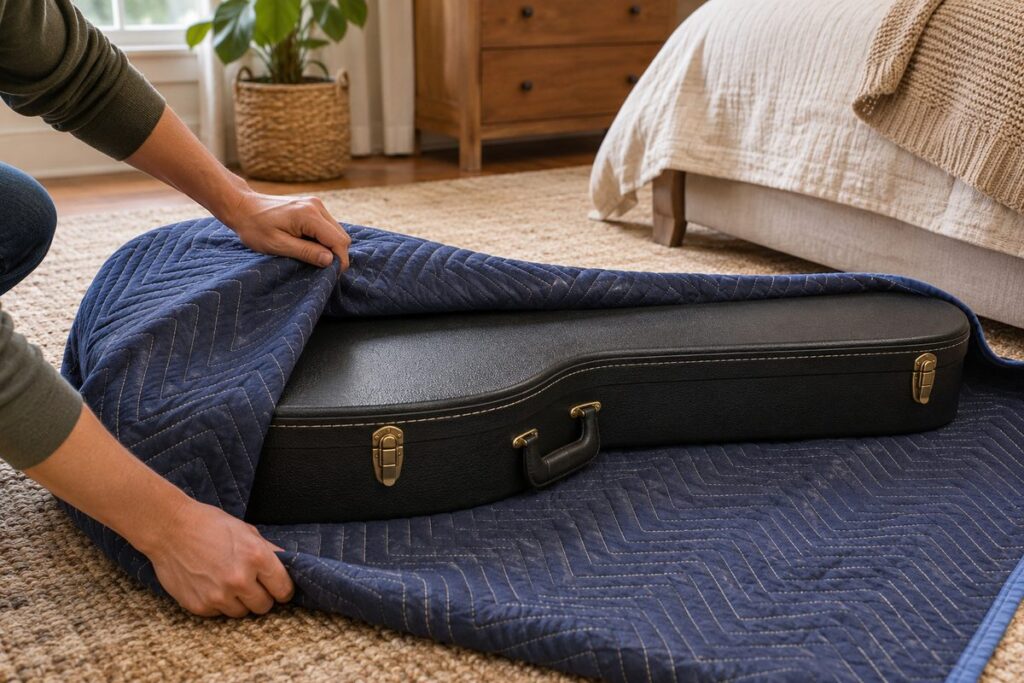
Here come the essential steps that explain how to pack a guitar for shipping during a house move.
- Step 1. Wrap carefully the headstock of your instrument with packing paper first, and then follow it with one or two sheets of Bubble wrap over it. Pay special attention to the safety of the tuning keys. Remember that the headstock is one of the most sensitive parts of the guitar, so you do want to protect it the best way you can.
- Step 2. If you own a soft case or a hard case, then things will be much easier for you and much safer for your prized stringed instrument. Place the guitar into the case after you’ve loosened slightly its strings. In case you don’t have such a protective case, then there are just a few things you need to do as extra protection /read the next step/.
- Step 3. If you’re packing a guitar for shipping without a case, then take a few sheets of soft packing paper and slide them between the strings and the fretboard to keep the two separated. The strings should not be touching the fretboard at any time during the actual relocation of your musical instrument.
- Step 4. The lack of a guitar case will force you to provide an additional layer of padding for the sensitive instrument. Wrap the entire length of your guitar in unprinted packing paper and then use clean hand towels or soft blankets to make a nice snug bundle. Next, place that bundle into the shipping box in such a position that the headstock is facing upward.
- Step 5. This step is a crucial one – add wads of crumpled paper (newspapers are also an option here) between the guitar case or the wrapped-up guitar (without a case) and the cardboard box to immobilize it. Nothing should be moving inside the shipping box. Use old pieces of clothing to fill in any remaining spaces. Before you decide you’re ready, lift the cardboard box and give it a slight shake – you shouldn’t feel anything moving inside it.
- Step 6. Tape shut the guitar shipping box, and mark the container as Fragile and This way up.
Match the method to your instrument
| Instrument | Main risk in a move | Best approach |
|---|---|---|
| Steel-string acoustic | Cracks from fast temperature and humidity changes; stress on the neck and bridge | Hard case, strings loosened, and a ride in the car with you rather than in a hot or cold truck |
| Classical (nylon string) | The same wood and humidity risks, with lighter bracing | Hard case and a ride with you. If you restring after the move, never fit steel strings |
| Solid-body electric or bass | Headstock breaks and knocks to tuners and controls | Hard case, or a padded gig bag inside a shipping box, with the headstock supported |
| Vintage, handmade or high-value guitar | Loss of value from any repair | Carry it yourself if you can. Otherwise ask the mover about specialty packing or crating, and have the case condition noted on the inventory |
Temperature and humidity: Martin recommends keeping its guitars at 45 to 55 percent relative humidity and 72 to 77 degrees Fahrenheit, and advises against letting an instrument ride in a car trunk, where temperatures swing widely. If the guitar has been in freezing temperatures, let it warm to room temperature while still in its case before you open it. Other makers publish their own ranges, so check yours.
If a mover carries it: on an interstate move, valuation is the mover’s liability for loss or damage, not insurance. Full Value Protection applies unless you sign a waiver, and the mover can limit its liability for any item worth more than $100 per pound unless you list it on the shipping documents. Ask your homeowners or renters insurer whether your policy covers the guitar in transit, or whether a separate instrument policy makes sense. A guitar you play every day can be packed last; use this guide to choose what to pack first.
Valuable info: How much does it cost to hire movers?





I’m planning to have my guitar shipped to my brother, that’s why I’m wondering whether there’s a foam insert service that can customize a case for it. I’m glad you shared this; I’ll also make sure to wrap it with soft packing paper. I’ll also keep in mind to wrap the cardboard box or any of my guitar’s container with packing tape.